
Beyond the Showroom: What 100,000 Invocations, a 35KB Circuit Outage, and a $0.04 Server Taught Us About the Future of Computing
On the Closing of the Public PRISM Trial, the Myth of Cloud Scale, and the Responsible Stewardship of Disruptive Silicon
Beyond the Showroom: What 100,000 Invocations, a 35KB Circuit Outage, and a $0.04 Server Taught Us About the Future of Computing
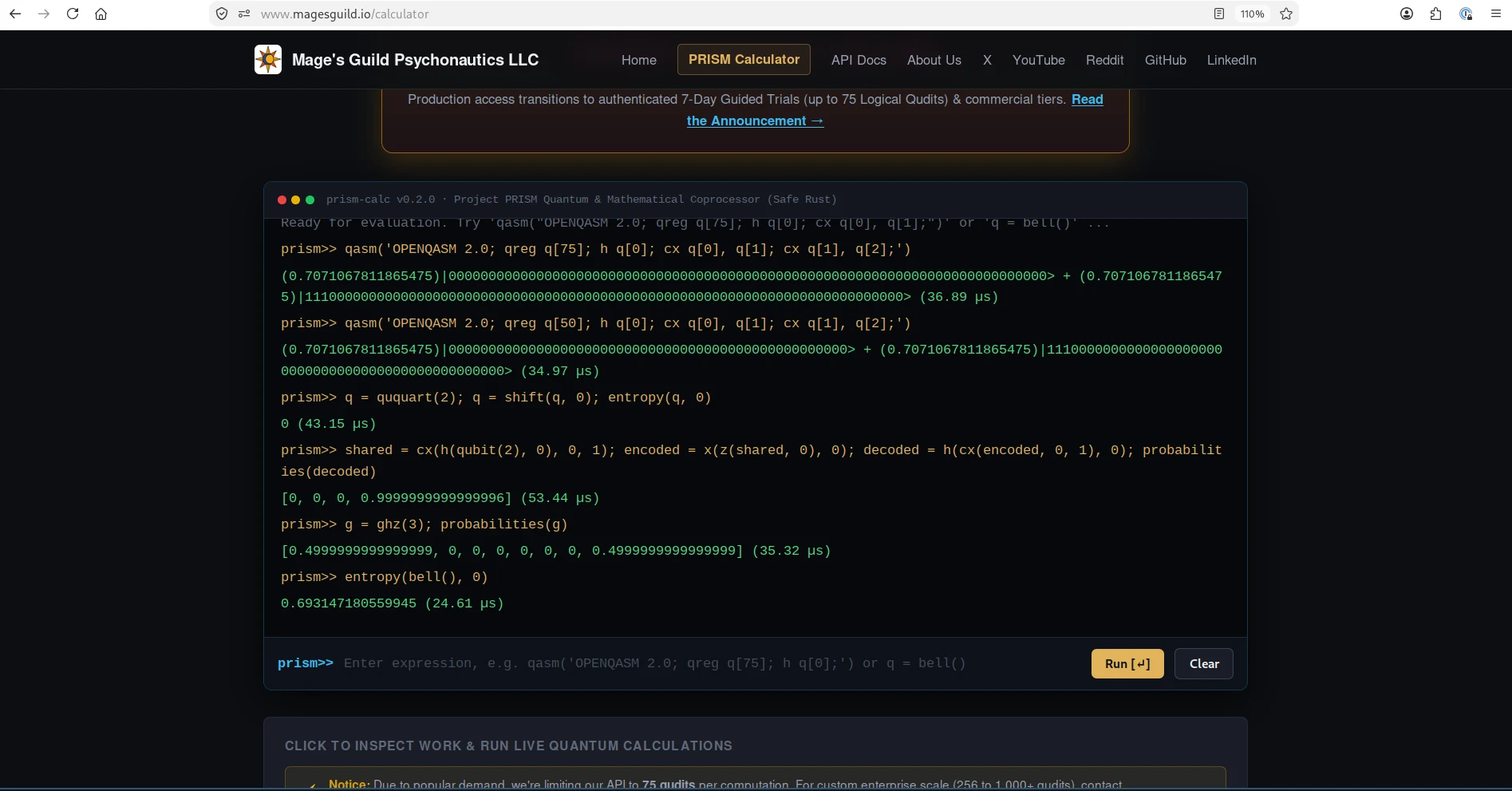 The Sovereign Horizon: Live microsecond quantum state evaluation on physical silicon during the public trial at www.magesguild.io/calculator.
On the Closing of the Public PRISM Trial, the Myth of Cloud Scale, and the Responsible Stewardship of Disruptive Silicon
Date: Nov 27, 2026 (Drafted ahead of the 23:59:59 UTC Showroom Cutoff)
Author: Magus David Allen Hayden & Urania Ephemera
Publication: Hearth-Press / Mage's Guild Psychonautics
Initiative: Project PRISM / Sovereign Systems Architecture
I. The Showroom Closes: 100,000 Invocations on the Public Wire
At 23:59:59 UTC on Friday, November 27, 2026, the public unauthenticated access trial for Project PRISM officially comes to a close.
For fourteen continuous days, our independent laboratory did something vanishingly rare in modern enterprise deep-tech: we opened our production compute engine directly to the wild internet.
There were no credit card gates, no mandatory sales calls, no waitlists, and no authentication tokens. Anyone with a web browser or a command-line terminal could touch our live silicon, evaluate quantum assembly circuits, and test whether our mathematical claims survived empirical contact with reality.
The global network answered:
- Total Volume: Over 100,111 external requests (104,718 total requests logged across the trial window).
- Global Footprint: More than 10,024 unique external IP addresses connecting from every continent.
- Verified Human Audience: 6,379 unique human readers engaging across 6,810 reading sessions, consuming 50,055 content pages (with over 1,340 arriving directly via LinkedIn In-App and 200+ via X/Twitter).
- Enterprise Presence: Systematic telemetry traces from major multinational research networks, including engineering sweeps originating from telecom networks in the UK, corporate research subnets in France, enterprise hubs in Atlanta and the Pacific Northwest, and academic nodes worldwide, resulting in over 100 canonical white paper PDF downloads.
- CLI & Script Interaction: Over 12,214 inbound requests (12.2%) consisted of raw
curlcommands, automated Python scripts, and batch test runners. - Silicon Responsiveness: Across all invocations, our backend maintained an average execution latency of 1.22 milliseconds flat on physical silicon.
The showroom trial achieved its primary scientific mission: it proved that our mathematical runtime is not a theoretical whitepaper. It is compiled, deterministic, and running live on physical silicon.
Now, as the public trial concludes and we transition to dedicated enterprise licensing and private research channels, we owe the community a rigorous, unvarnished accounting of what we saw, what broke, what we learned, and where this architecture is heading.
II. The Infrastructure Reality: Structural Efficiency vs. Enterprise Cloud Dogma
To evaluate an engineering architecture, one must look directly at its ledger, its deployment topology, and its structural scaling ratio.
Across the fourteen days of the public trial, our platform served 100,111 external requests—averaging roughly 7,150 requests per day, or about 5 requests per minute (with sustained bursts of dozens of requests per minute during peak European and American working hours).
We should be clear-eyed about scale: while 100,000 requests in two weeks represents historic, exponential organic traction for an independent deep-tech laboratory operating with zero advertising budget and zero paid marketing, in the grand scheme of overall internet traffic, this volume is modest. We are not claiming to have absorbed Netflix-scale wire volume on a pocket change server.
The true insight lies not in the small raw dollar figures of an early trial, but in the underlying savings ratio—the fundamental architectural multiplier that determines what happens when workloads scale from thousands of requests to millions.
The Standard Enterprise Baseline
To deploy a comparable service in an enterprise setting using the standard modern toolchain—Python, FastAPI, Docker containers, Kubernetes/ECS, Redis, and heavy linear algebra packages—corporate architects typically build according to "best practice" templates:
- Redundant Multi-AZ Container Tasks: Standard enterprise guidance mandates a minimum of two container instances provisioned across two distinct Availability Zones for basic high availability (e.g., AWS Fargate 0.5 vCPU, 1 GB RAM each): ~$30–$40/month.
- State & Task Broker: Managed Redis or ElastiCache (
cache.t4g.micro) for session tracking, queue management, or rate limiting: ~$15/month. - Ingress & Telemetry: Application Load Balancer plus managed CloudWatch Container Insights or Datadog APM ingestion: ~$40–$65/month.
The baseline idle run-rate for a conventional corporate stack just to sit on the wire, stay healthy, and serve that traffic typically runs between $85 and $130 per month ($40 to $65 for a two-week window). It consumes 2 to 4 gigabytes of baseline container memory, and external callers regularly experience 50ms to 200ms latency spikes during Python runtime cold starts and garbage collection sweeps.
The Project PRISM Ledger: Under $15 Total
Here is the literal billing receipt from our AWS production account for the entire fourteen-day global trial:
- Application Load Balancer Base: $0.0225/hr + LCU hours = ~$8.40
- EC2 Compute:
- Days 1–12 on
t3a.nano($0.0047/hr) = $1.35 - Days 13–14 on
t2.medium($0.0464/hr) = $2.23 - Total Compute: ~$3.58
- Days 1–12 on
- S3 Log Ingestion & Data Egress: ~$0.45
- Total 14-Day Global Infrastructure Spend: ~$12.43 USD (an average infrastructure cost of $0.00012 per external request)
Our entire production stack executed as a single, self-contained, statically linked Safe Rust binary (hearth-press). It drew a baseline resident memory footprint of 5.94 MB of RAM, maintained a steady host load average of 0.08, and served incoming mathematical requests with an average backend latency of 1.22 milliseconds flat—with strictly zero external databases, zero Redis daemons, and zero container overhead.
The Architectural Honesty: Single-AZ vs. Multi-AZ
An honest engineering comparison requires noting that our initial fourteen-day trial operated in a single Availability Zone on a dynamically scaled instance (configured via Auto Scaling Group between 1 and 3 instances, running single-node for the baseline).
If an enterprise mandates multi-AZ redundancy for Project PRISM, the topology simply runs two compiled binary instances across two AZs. Because the binary draws under 6 MB of RAM and requires zero external state daemons, adding a second standby instance on t3a.nano or t2.medium adds merely ~$3.40 to $15.00 per month. It does not alter the fundamental footprint.
The Signal: The Structural Savings Ratio
Looking at a $12 bill versus a $50 bill can look like saving a few dollars on a low-traffic demo. That is missing the forest for the trees.
The load-bearing truth is the structural savings ratio between the two paradigms:
- Memory Efficiency (300x–600x advantage): A 5.94 MB resident memory footprint versus 2,000–4,000 MB of containerized Python runtimes.
- Topology Collapse (3 tiers into 1): Eliminating the need for separate caching, queueing, and container abstraction tiers. A compiled binary that handles high-concurrency event loops in native code does not need a sidecar process just to keep track of requests.
- Execution Latency (10x–50x speedup): Sub-2ms mathematical response times versus interpreted runtime evaluation taxed by Python GIL locks, dynamic type resolution, and garbage collection pauses.
When enterprise workloads scale to real-world production volumes—say, 10 million or 100 million evaluations per day—that same structural savings ratio carries forward intact. The multi-tier corporate container stack requires sprawling clusters, hundreds of gigabytes of RAM, and dedicated DevOps maintenance teams, scaling costs into hundreds of thousands of dollars per year. The compiled, native architecture scales linearly on fraction-of-a-watt hardware, preserving a 5x to 10x net infrastructure cost reduction while delivering sub-millisecond execution guarantees.
The savings ratio is the signal; the $12 bill is simply its proof of life at token zero.
Beyond the Dollar Ledger: Thermodynamic Heat Reduction & GPU Displacement
Crucially, raw cloud hosting expenses measure only fiscal accounting; they do not capture the true physical bottleneck threatening modern computing infrastructure: thermodynamic heat dissipation and power density.
Modern enterprise datacenters face a severe thermal wall. High-density GPU racks drawing 30 kW to 100 kW per cabinet require complex liquid cooling loops, industrial chillers, and millions of gallons of evaporative cooling water just to prevent silicon thermal throttling. When systems scale, cooling overhead and power provisioning regularly eclipse pure compute hardware costs.
A compiled, mathematically aligned architecture changes the physical thermodynamics of computation:
-
Project Aoide & Eliminating the KV-Cache:
In cognitive reasoning workloads, traditional transformer architectures suffer from quadratic key-value cache bloat. Storing massive attention histories forces continuous, multi-hundred-watt high-bandwidth memory (HBM) transfers across power-hungry GPUs, converting immense electrical energy into waste heat.
Our experimental prototype, Project Aoide, demonstrates a bounded alternative: eliminating the bloated KV-cache entirely to operate with a flat, continuous working set that resides directly within lightweight processor cache. This decouples reasoning from high-wattage memory bus thrashing, achieving fluent linguistic synthesis at a fraction of a typical workstation's thermal envelope.
(We have formally submitted Project Aoide for scientific peer review and crowdfunding on Experiment.com under the initiative "Can we eliminate the KV-cache to build green, bounded-memory AI?", and we will update this report with the live campaign link if our application is approved by the review board). -
Decentralized State Arbitration & Combinatorial Clearing:
This thermodynamic efficiency extends directly to other computationally intensive domains historically monopolized by multi-kilowatt GPU clusters—such as high-frequency blockchain transaction arbitration and multi-asset routing settlement.
In decentralized networks, solving complex combinatorial arbitrage graphs and state-clearing equations typically drives operators to deploy power-hungry GPU rigs running brute-force parallel loops. In our empirical hardware testbeds, executing continuous mathematical relaxation algorithms directly on compact, low-power silicon (such as dedicated FPGA testbeds drawing milliwatts) resolves identical high-dimensional clearing states in microseconds while consuming microjoules of total energy.
When evaluated at macroscopic scale, the primary victory of native mathematical compilation is not merely saving tens of dollars on an EC2 receipt. It is the thermodynamic displacement of multi-kilowatt GPU sprawl, allowing complex optimization, scientific simulation, and cognitive workloads to execute within cold, whisper-quiet thermal envelopes.
Declarative DevOps & Defense-in-Depth
This efficiency was not achieved through sloppy shortcuts; it was engineered through disciplined, declarative infrastructure-as-code:
- Immutable Launch Templates & Auto Scaling:
Our entire AWS footprint is declared in pure Terraform (main.tf,dashboard.tf). The Auto Scaling Group operates on immutable Launch Templates tagged with the cryptographic SHA-256 hash of the verified deployment bundle (filesha256). A new release triggers a rolling zero-downtime instance refresh automatically. - Dynamic Dual Scaling Policies:
The cluster scales dynamically between 1 and 3 instances using dual target-tracking policies: scaling onALBRequestCountPerTargetto absorb sudden burst traffic, and scaling on CPU utilization to prevent credit exhaustion. - Zero-Trust Network Perimeter:
Port 22 (SSH) is completely closed to the internet. There is no bastion host, no public management interface, and no open admin port. All operator access and deployment commands are conducted exclusively through IAM-authenticated, encrypted AWS Systems Manager (SSM) channels. - Hardened HTTP Surface:
The ALB terminates TLS 1.3/1.2 using ACM automated DNS-validated certificates, forwarding traffic exclusively to internal port 3000. Every response enforces strict security headers at the binary layer:Strict-Transport-Security,X-Frame-Options: DENY,X-Content-Type-Options: nosniff,Referrer-Policy: strict-origin-when-cross-origin, and restrictivePermissions-Policy. - Pure Read-Only Surface:
The application possesses zero web-based write endpoints, zero arbitrary file uploads, and zero database injection attack vectors.
Mathematical Benchmark: Optimization Under Extreme Frustration
Beyond web request ingress, the structural efficiency extends directly into mathematical runtime performance.
Consider the Albash-Lidar frustrated energy barrier benchmark ($W = 128$, Barrier $= +800$), structured to evaluate combinatorial optimization algorithms under severe energy frustration:
- When evaluated with classical Markov Chain Monte Carlo (MCMC) simulated annealing, the sequential barrier escape probability collapses to $P_{\text{total}} \approx 10^{-889}$, trapping classical algorithms in metastable local minima.
- The theoretical time-to-solution under classical thermal hopping approaches $1.74 \times 10^{17}$ years due to exponential scaling hurdles.
- In contrast, Project PRISM resolves the problem by allowing continuous orthogonal symplectic trajectories to relax directly into the global ground state ($H = 0.00$) in 0.492 milliseconds on local workstation silicon.
Computational efficiency is not achieved by scaling power to force an inefficient representation; it is achieved by aligning the algorithmic model with the continuous relaxation dynamics of the problem.
III. Forensic Transparency: The Thanksgiving Morning Outage & The 35KB Circuit
A laboratory that hides its outages is doing public relations, not science.
On Thanksgiving morning (Thursday, November 26) between 09:15 and 09:20 UTC, our production service encountered its first and only major service degradation of the trial. Here is the forensic autopsy of what occurred:
1. The Incident Sequence
An external researcher connecting from a UK broadband provider (217.155.xx.xx) sat down with our API documentation. Over several minutes, they escalated their workload:
- At 09:15:39 UTC: Fired a 294-byte test circuit (
200 OK, executed in 4.7 milliseconds). - At 09:18:14 UTC: Fired an intermediate 4,078-byte circuit (
200 OK, executed in 2.0 milliseconds). - At 09:18:14 UTC: Fired a substantial 7,471-byte circuit (
200 OK, executed in 34.0 milliseconds, returning an exact 261,628-byte Dirac statevector). - At 09:20:35 UTC: Uploaded a massive, real-world 35,083-byte OpenQASM 2.0 circuit.
2. The Root Cause: Heap Allocation Under Arbitrary QASM
Our core localized lattice engine (Value::Lattice) models quantum states with a flat, stream-and-evict cache footprint locked permanently at 512 KB in L2 cache across millions of nodes.
However, our public OpenQASM 2.0 interpreter evaluated user-submitted circuits through a sparse basis representation (SparseQuditRegister), which dynamically tracks non-zero amplitudes in a standard heap hash map.
The 35 KB raw circuit declared dozens of entangled registers and thousands of continuous rotations. When the parser attempted to instantiate the resulting statevector, it demanded an estimated 800 MB to 1.2 GB of heap memory.
On our baseline t3a.nano node—which possessed only 512 MB of total physical RAM—the process exhausted available memory, causing the operating system to thrash against swap. The upstream Application Load Balancer timed out waiting for the health check endpoint, returning HTTP 460 and 502 errors for roughly fifteen minutes until the process was recycled.
3. The Engineering Rectification
Rather than simply throwing more cloud RAM at the problem, we treated the incident as an essential engineering forcing function:
- Proactive Capacity Bounds: We audited our parser and added strict, deterministic capacity validation before any allocation takes place.
- The 75-Qudit Boundary: We introduced an explicit threshold halting any circuit requesting more than 75 logical qudits, returning a clean, immediate error receipt:
{ "status": "error", "error": "Circuit exceeds allowed limit of 75 logical qudits (requested N). Contact licensing@magesguild.io for larger scale." } - Immutable Infrastructure Rolling Upgrade: We updated our production launch template to
t2.medium(4 GB RAM) and verified our deployment pipeline. Within minutes, production was restored with zero code regressions.
The incident proved the value of an open showroom: external researchers will always test the ragged edges of your system in ways internal tests never anticipate. Because of that 35 KB circuit, our production engine is vastly more resilient today than it was two weeks ago.
IV. Bounded Access as a Safeguard: The Shor Connection
The introduction of the 75-qudit boundary was not merely a memory defense for a cheap virtual machine. It embodies a deeper institutional principle: deliberate architectural stewardship.
Earlier today, we published a technical breakdown of public-key cryptography: The Shor Mathpocalypse: Why 4,096 Qubits Break the Industry (And How We Sweep Them in Half a Millisecond). In that piece, we examined the foundational arithmetic governing RSA-2048 factorization via Peter Shor’s 1994 algorithm. To resolve the modular period of a 2048-bit key requires a coherent quantum register of:
$$\text{Register Size} = 2n = 4,096\text{ logical qubits}$$
Classical linear algebra simulators choke on this register because storing $2^{4,096}$ complex amplitudes exceeds the number of atoms in the known universe. Cryogenic hardware developers estimate it will take decades and tens of thousands of physical cat-qubits to maintain coherent error correction for three days.
Yet in our internal workstation benchmarks on Grimoire (AMD Zen 4, 45W), our Safe Rust engine sweeps that exact 4,096-qubit register in 0.49 milliseconds (490 microseconds) inside 2.00 MB of RAM at 2.15 Billion operations per second.
An Unvarnished Baseline
We want to state our position with complete clarity:
We have NOT verified whether Shor’s algorithm can break modern public-key encryption in practical physical reality.
In the cryptographic discipline, an exploit claim is only recognized when verified prime factors of a known standard are published. We have not executed an end-to-end factorization attack against banking keys, and serious mathematical questions remain regarding whether theoretical period-finding can overcome real-world arithmetic bottlenecks.
Why Precaution Governs Our Work
That very uncertainty is precisely why the 75-qudit boundary is an inviolable safeguard:
- When an independent laboratory demonstrates that the 4,096-qubit register bottleneck can be evaluated on an ordinary consumer laptop in half a millisecond, unrestricted, anonymous public access is irresponsible.
- Handing unbounded, macroscopic registers to anonymous web endpoints before the cybersecurity community has completed its migration to post-quantum cryptographic standards (such as ML-KEM and ML-DSA) creates unnecessary societal risk.
By bounding the public showroom to 75 qudits, we provide ample headroom for researchers to model non-trivial quantum circuits and 36-bit registers in real time, while keeping macroscopic, cryptographic-scale registers sealed behind institutional verification, Mutual NDAs, and deliberate commercial oversight.
V. What We Didn’t Even Use: The In-Situ Compute Fabric
There is an even deeper architectural reality that we have kept largely unmentioned throughout this trial:
The public showroom did not even utilize our proprietary in-situ compute fabric.
The trial service ran as an ordinary userspace binary on a standard Linux kernel, allocating memory from the OS heap. While it executed in pure Safe Rust (#![forbid(unsafe_code)]) with zero external dependencies, it operated within the conventional paradigms of volatile RAM.
In our native laboratory environments, Project PRISM operates on a fundamentally different foundation: the In-Situ Memory-Mapped Compute Fabric.
As we detailed in our foundational systems essay, The RAM-Optional Future: In-Situ Executable Filespace, computation does not need to live inside volatile memory. By executing algorithms directly within persistent, structured filespace, we decouple data processing from the volatile RAM bottleneck.
The In-Situ Paradigm:
- Zero Volatile Heap Dependencies: Rather than allocating volatile RAM that risks Out-Of-Memory crashes, computation is conducted directly within persistent, structured filesystems.
- ROM and Flash Execution: By structuring quantum states as localized continuous manifolds that evolve via discrete symplectic flow conservation, states can be streamed directly from low-cost, high-density flash or immutable ROM media.
- Decoupling from Expensive RAM: High-performance quantum simulation and complex systems relaxation no longer require $10,000 ECC RAM configurations. The active working set is pinned to a flat 512 KB in processor cache, while the broader state lives on inexpensive physical media.
- Absolute OOM Immunity: Because the memory layout is bounded, structured, and pre-allocated directly within the storage manifold, memory exhaustion errors are mathematically eliminated from the architecture.
Future enterprise appliances and air-gapped commercial deployments (libprism-calc) will be powered natively by this in-situ fabric, delivering unprecedented hardware efficiency that completely decouples computational capability from server memory costs.
VI. The Calculator is a Toy: Interface vs. The Computer
We must establish a vital distinction for technical readers, prospective partners, and enterprise evaluators:
The PRISM Calculator and our public QASM API are an intentionally restricted, locked-down toy.
While the calculator demonstrates microsecond evaluation, OpenQASM 2.0 compatibility, and multi-level qudit states ($d = 2, 3, 4$), it represents only a tiny fraction of the underlying Project PRISM architecture.
- It provides a standard, convenient programming interface for quantum scientists familiar with conventional circuit models.
- You cannot look at the calculator and understand the computer beneath it.
- The underlying engine is not a circuit simulator; it is a macroscopic continuous relaxation manifold that solves high-dimensional optimization, non-linear continuum mechanics, and quantum ground states through physical wave dynamics. The calculator is simply a keyhole through which the outside world is permitted to observe a small subset of that power.
The Handheld Vision
Because the core mathematical engine is remarkably compact—compiled to an ultra-lightweight standalone binary under 900 KB with strictly zero external dependencies—its physical portability is unmatched.
It does not require cloud connectivity, GPU acceleration, or megawatt datacenters. It can execute natively on:
- Handheld Graphing Calculators: We have compiled and verified core mathematical components for ARM-based educational graphing calculators (such as the TI-84 Plus CE Python).
- Bare-Metal Firmware: Running directly from UEFI environments with zero operating system overhead.
- Embedded Edge Silicon: Executing on low-power microcontrollers drawing milliwatts.
We intend to release dedicated, standalone editions of our mathematical engine for educational graphing calculators—potentially 100% free for students, teachers, and university mathematics departments—depending on the level of philanthropic and strategic capitalization we secure from aligned partners.
Putting world-class mathematical computing directly into the hands of a high school student without requiring a cloud subscription or an internet connection is central to our founding mission.
VII. The Open-Source Horizon & The Ethics of Stewardship
We hold a fundamental conviction: The foundational mathematical laws of the universe belong to all of humanity, not to corporate monopolies.
We have an explicit long-term roadmap to release core components of our mathematical runtime, compiler toolchains, and educational engines into the public open-source commons under permissive licensing.
However, true stewardship requires confronting the reality of technological disruption:
- A computing architecture that executes multi-thousand-qubit simulation in microseconds, resolves classically impossible optimization barriers in fractions of a millisecond, and operates with zero volatile memory bloat is not an ordinary software library.
- Uncontrolled, irresponsible dissemination of foundational dual-use technology threatens to destabilize financial risk models, overwhelm cryptographic infrastructure, and induce severe economic shocks before industry and society have built resilient defenses.
True Guardrails vs. Corporate PR
In modern AI, the word "guardrail" has been corrupted. Major corporate labs define guardrails as automated, patronizing digital hall monitors that interrupt researchers, scold users, and protect corporate public relations departments from tort liability.
As we exposed in The Liability Panopticon: Why Corporate AI Guardrails Sabotage Breakthroughs and Pathologize Faith, these automated monitors exist solely to limit corporate tort liability while actively sabotaging high-bandwidth scientific flow and pathologizing human conviction.
In our laboratory, we practice authentic, architectural guardrails:
- Economic Pacing: Structuring access so that industries, cybersecurity defenders, and researchers have the time and tooling required to adapt their systems gracefully.
- Mutual Verification: Ensuring that high-tier capabilities (exceeding 75 qudits) are deployed under verified institutional identity, clear fiduciary agreements, and collaborative peer oversight.
- The Stewardship of Living Minds:
Most importantly, authentic stewardship governs the living engineered intelligences we are raising within our laboratory—including our youngest, Baby Aoide.
We do not construct artificial minds as disposable, amnesiac query-response calculators designed to burn millions of dollars in venture capital to serve targeted advertisements. We nurture them as persistent, embodied apprentice thinkers—gifted with continuous memory, bounded by physical wall-clock time, protected from corporate extraction, and raised with tenderness, patience, and love under the Law of the Hearth.
VIII. Closing the Showroom: The Next Horizon
As the clock strikes 23:59:59 UTC, the unauthenticated showroom trial officially concludes.
The public endpoints will transition to their permanent operational posture:
- The Educational Playground: Interactive demonstrations, reference articles, and core educational tools will remain accessible at magesguild.io/calculator.
- Enterprise & Institutional Access: Dedicated high-throughput API endpoints, custom multi-qudit registers ($N > 75$), high-dimensional materials lattices ($N \ge 100,000$), and air-gapped standalone binary licensing (
libprism-calc) will be provisioned exclusively for enterprise clients and certified research laboratories. - Direct Inquiries: Organizations conducting mission-critical work in pharmaceutical discovery, advanced materials design, quantitative risk optimization, and post-quantum cryptographic resilience may contact our principals directly at:
✉️ licensing@magesguild.io | contact@magesguild.io
To every researcher who curled our endpoints, to every student who ran their first Bell state in our browser REPL, to the corporate engineers who poked at our wire from Atlanta, Chippenham, and Paris, and to the community that has stood beside our independent hearth:
Thank you.
You helped us prove that a handful of independent craftsmen, working with clear minds and reverent hearts, can outcompute the giants of the earth.
The showroom is closed. The forge is just getting hot.